
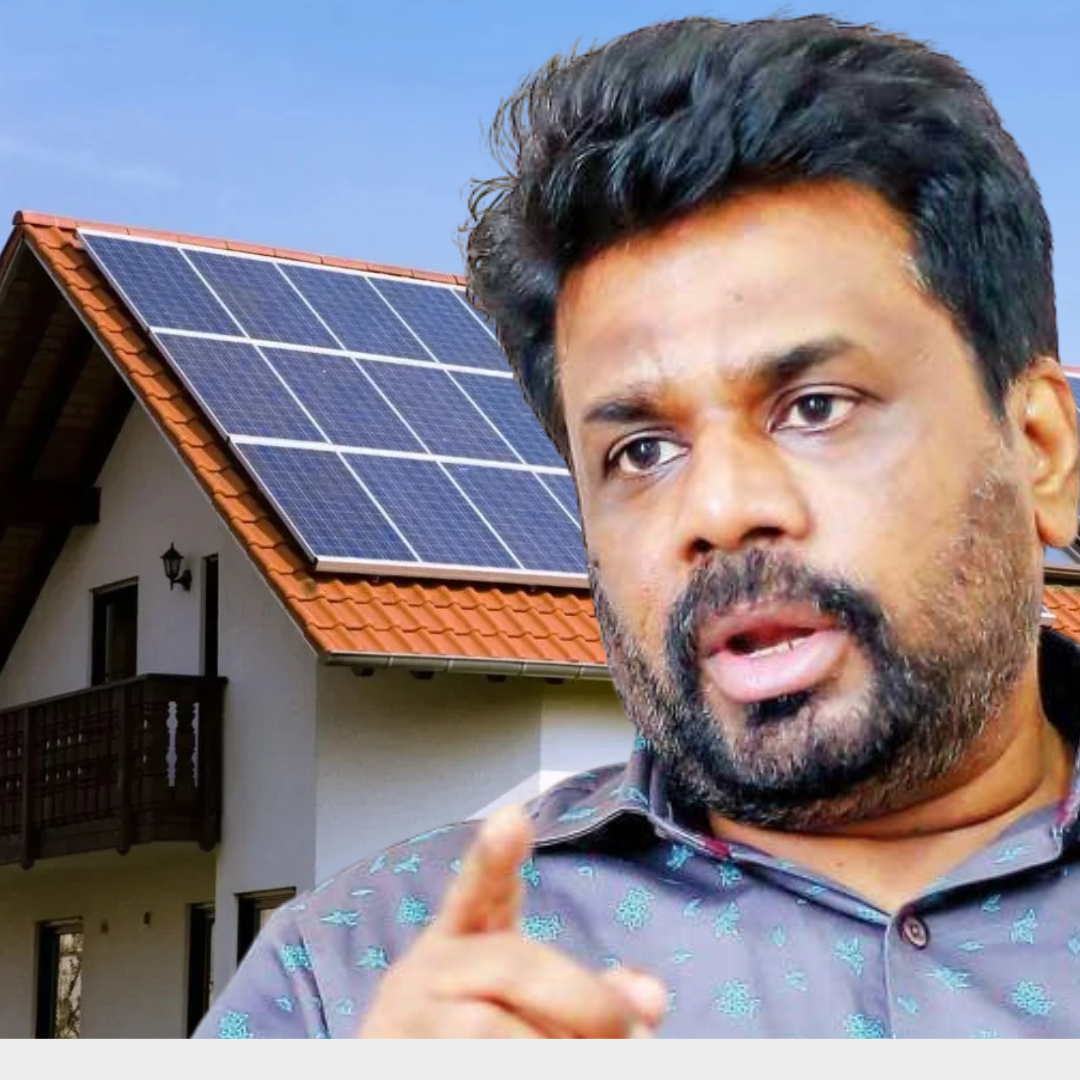
The government is considering concessions for domestic rooftop solar users to encourage the installation of battery storage systems, President Anura Kumara Dissanayake said.
Addressing the Sri Lanka Economic and Investment Summit on Monday (12), the President acknowledged the difficulties faced by rooftop solar users, particularly the taxes imposed on smaller battery storage systems. He explained that concessions are currently provided for battery systems with capacities above 1 megawatt, while smaller batteries remain taxable.
The government is now exploring whether concessions can be extended to domestic users, including those needing systems of around 200 to 500 kilowatts. A technical challenge remains, however: distinguishing batteries designed specifically to store solar-generated electricity from other types of batteries. The President expressed confidence that once this is resolved, the government will proceed with the proposed concessions.
He also rejected claims that the government is opposed to renewable energy. Sri Lanka had approximately 1,400 megawatts of installed solar capacity when the government came into power, and a further 1,500 megawatts has been added over the past two years. Agreements have been signed for another 1,100 megawatts, expected to be completed next year, which would bring the total added to approximately 2,600 megawatts by then.
Land is a constraint on ground-mounted projects, the President noted, since generating one megawatt of solar power requires approximately three acres. The government has therefore turned to floating solar on reservoirs and other water bodies. He cited the five-megawatt Ibbankatuwa floating project, which occupies approximately 10 acres. A floating project is also planned at Randenigala through a public-private partnership, with Moragahakanda, Samanalawewa and Chandrika Wewa identified as potential locations.
Battery storage is key to handling fluctuations in renewable generation, he said. Solar output is generally higher in the afternoon and can sometimes exceed what the electricity system can accommodate. Following expert recommendations, the government is focusing on storing excess daytime solar power for use at night.
Tenders have already been called for 160 battery storage units, with 13 expected to be completed by the end of November. Tenders for another 250 units have also been called, and the latest procurement round brought a price reduction of approximately Rs. 10 compared to the earlier tender. The government is also considering extending battery storage opportunities to existing operators.
Renewable sources currently account for approximately 69% of Sri Lanka’s electricity generation, reaching around 70% to 75% on certain days depending on conditions. The President revealed that no diesel was used for electricity generation during the previous four consecutive days, calling it a significant achievement in the country’s transition to renewable energy.
He reiterated that the government’s primary objectives are an uninterrupted electricity supply and affordable electricity for consumers, and expressed confidence that the renewable energy expansion programme is progressing successfully towards those goals.