
Not everyone who wants solar power has a roof suited to install it on — and Sri Lanka just secured a major financing package aimed squarely at fixing that gap.
The Government has signed off on financing from the Asian Development Bank (ADB), together with grant assistance from the European Union (EU) and the Government of Japan, for the Rooftop Solar Integration and Virtual Net Metering Project — an initiative designed to widen access to affordable, clean energy across the country.
The numbers behind the deal: a concessional loan of USD 35 million from the ADB, a grant of EUR 15.4 million from the European Union (roughly USD 16.94 million), and a further USD 5.5 million grant from the Japan Fund for the Joint Crediting Mechanism (JFJCM). Combined with counterpart funding from the implementing agencies, the project’s total value comes to USD 80.5 million.
The Ministry of Energy will lead the rollout in partnership with Electricity Distribution Lanka (Private) Limited (EDL) and Lanka Electricity Company (Private) Limited (LECO), running the project from 2026 through 2030.
At the technical core of the upgrade is a significant digital overhaul of EDL’s existing CEBAssist solution. The project will introduce an Advanced Metering Infrastructure (AMI) system, a Distributed Energy Resource Management (DERM) system, and new distribution control centres powered by an Advanced Distribution Management System (ADMS) — a package expected to digitalise EDL’s customer and operational services while enabling faster power restoration after outages.
Smart meters and related infrastructure will also give operators real-time visibility and control, a capability essential for expanding renewable energy use and extending the benefits of solar power to a broader base of consumers — ultimately supporting a more efficient, reliable, and sustainable smart grid.
Perhaps the most significant element of the project is the introduction of Virtual Net Metering (VNM) to Sri Lanka for the first time. Through EU grant financing, 25 MW of aggregated rooftop solar photovoltaic (PV) capacity will be deployed specifically to ease the electricity cost burden on small and medium-scale entrepreneurs — the very group that often can’t afford or physically install solar panels of their own. These solar installations will come equipped with advanced control capabilities, allowing the National System Operator to manage output in line with network constraints.
Within LECO’s service area, the project will also bring low-loss conductors alongside the VNM scheme to boost distribution network efficiency, while high-capacity battery energy storage systems installed at the distribution transformer level will expand the network’s capacity to absorb renewable energy — giving operators greater control over how that energy is managed.
The Negombo area has been flagged for particular attention. LECO expects the project to strengthen network capacity for connecting larger commercial and industrial loads, while making the broader system more flexible, resilient and reliable.
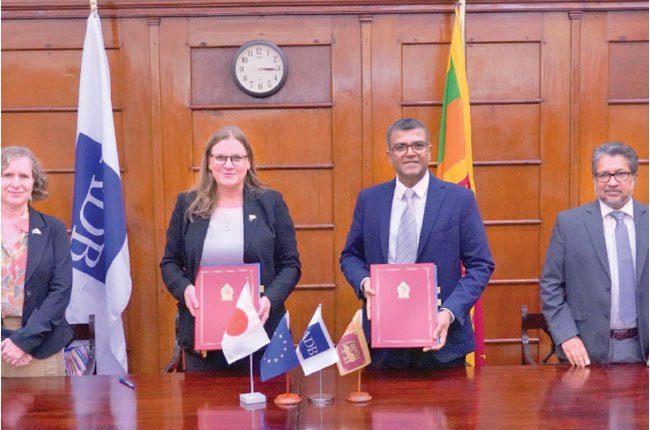
The agreements were formalised at a signing ceremony held at the General Treasury in Colombo on October 1, 2026. Dr. Harshana Suriyapperuma, Secretary to the Ministry of Finance, Planning and Economic Development, signed on behalf of the Government of Sri Lanka, while Shannon Cowlin, ADB Country Director for Sri Lanka, signed for the Asian Development Bank. Also present were Virginie Laffeur-Tighe, Head of Partnerships at the Delegation of the European Union to Sri Lanka, and Naoki Kamoshida, Deputy Chief of Mission (Minister) at the Embassy of Japan in Sri Lanka.